Views: 0 Author: Site Editor Publish Time: 2026-06-05 Origin: Site


The rapid accumulation of bulky municipal solid waste creates serious logistics problems today. Transfer stations and landfills struggle daily. Items like furniture, mattresses, and large appliances pile up quickly. They create disproportionate processing and handling costs. Unprocessed large items consume valuable airspace. They require excessive compactor passes on the active face. This increases heavy equipment fuel usage and drives up maintenance costs. Furthermore, intact springs and fractured wood risk puncturing composite landfill liners.
Implementing an industrial shredder solves these fundamental problems immediately. It pivots operations from an inefficient direct-landfill approach. We transition toward an optimized early size reduction model. It strongly supports broader resource recovery efforts. You will learn how early size reduction protects heavy equipment. We will explore core engineering mechanisms behind these systems. You will also discover standard workflows and downstream monetization strategies. Properly processed materials turn former waste liabilities into predictable secondary revenue streams.
Volume Reduction: Low-speed, high-torque shredding compresses large waste volume by up to 75%, drastically preserving landfill airspace and cutting direct transport costs.
Process Protection: Pre-shredding eliminates sharp edges and voids, reducing compactor passes by 50% and mitigating leachate risks from punctured liners.
Material Monetization: Standardized processing (sizing to 40–100mm) enables automated magnetic separation of steel and prepares wood/textiles for Refuse-Derived Fuel (RDF).
System Reliability: Modern units utilize anti-wind fixed blades and automatic overload reversing to handle notoriously difficult items like inner-spring mattresses without continuous jamming.
Unprocessed hollow items contain trapped air voids. Sofas and wardrobes are prime examples. Landfill compactors struggle to crush them effectively. The heavy wheels often ride entirely over the flexible frames. Shredding eliminates these structural voids completely. It allows for much tighter compaction densities. This minimizes the volume of daily soil cover needed. The Resource Conservation and Recovery Act (RCRA) demands specific daily cover ratios. You save significant soil resources and machine labor.
Pre-shredded material significantly improves heavy equipment life spans. It reduces necessary compactor passes by up to half. You burn far less diesel fuel daily. Operators minimize severe wear and tear on moving parts. Facilities drastically cut overall operational labor hours.
Intact furniture contains sharp metal springs. Fractured wood splinters dangerously under pressure. These materials easily pierce bottom composite liners. A punctured liner creates highly expensive liabilities. Toxic leachate leaks directly into surrounding groundwater. Facilities face severe regulatory fines. Shredding dulls and resizes these distinct physical threats. You actively protect the structural integrity of the landfill base.
Transfer stations face distinct high freight costs. Shredding bulky items prior to loading changes the economic math. It maximizes overall truck payload density. You ship fewer half-empty transport trailers. Systems designed for direct-dump operation work incredibly well. Trucks unload straight into a wide-open hopper. This eliminates expensive secondary material handling. It removes dedicated feeding equipment from the active floor plan. Implementing professional oversized waste processing transforms overall facility economics.
High-speed grinders fail entirely on flexible materials. Low-speed shredding cleanly tears through abrasive items instead. It handles bulky materials without generating excessive heat. This mechanical approach requires far less energy per processed ton. It keeps airborne dust levels strictly controlled. Operational noise stays within highly safe environmental thresholds. A well-designed bulk waste machine relies heavily on this fundamental principle.
Mattresses remain notoriously difficult for modern waste facilities. They rapidly wrap textile fibers around rotating machinery shafts. High-tensile steel wires tangle instantly. Equipment evaluation must demand specific engineered features. You need robust anti-wind fixed blade designs. Programmable Logic Controller (PLC) reverse systems are strictly mandatory. They clear difficult material jams without human manual intervention. Operators stay safe while uptime remains consistently high.
Large hollow items often float in standard hoppers. The cutting rotors cannot grab them easily. Credible manufacturing systems utilize a wide-open hopper design. They pair it successfully with a vertical hydraulic pusher. This heavy steel ram forces awkward items downward into the cutting chamber. You maintain consistent throughput metrics despite awkward item shapes.
Primary cutting chambers endure massive mechanical stress daily. We highly recommend specifying wear-resistant alloy steel shafts. Rapid-exchange blade systems save countless hours. They minimize crippling downtime during scheduled maintenance intervals. You resume profitable operations much faster.
Engineering Feature | High-Speed Grinder | Low-Speed Shredder |
|---|---|---|
Rotor Speed | High RPM (Creates immense dust) | Low RPM (Dust suppression optimized) |
Torque Output | Low Torque (Relies on momentum) | High Torque (Aggressive tearing power) |
Mattress Handling | Fails (Wires tangle immediately) | Succeeds (Anti-wind blades strip wires) |
Noise Levels | Exceeds standard occupational limits | Stays well within safe limits |
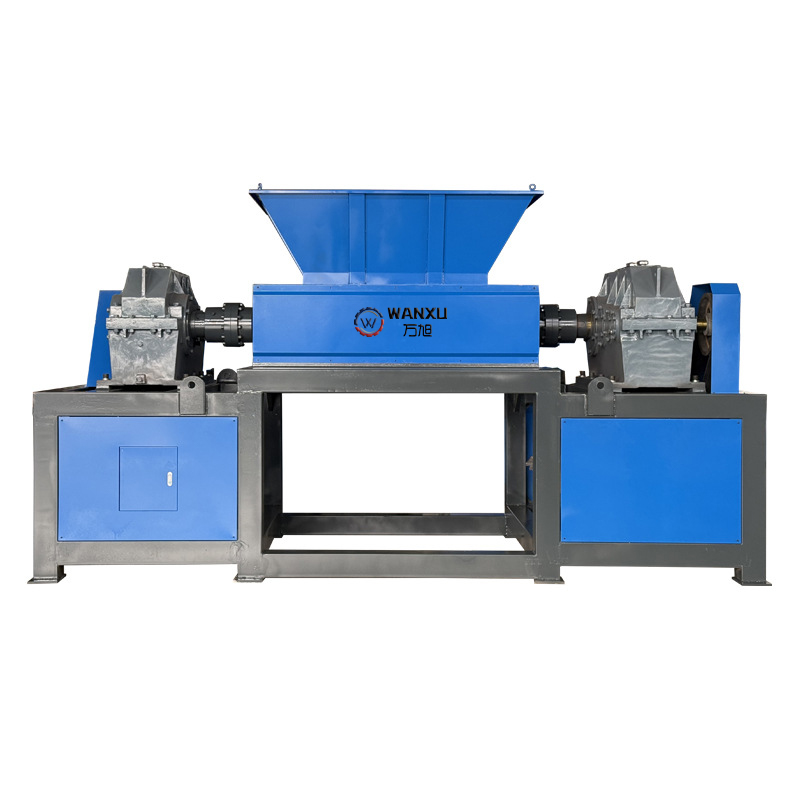
Operating a professional large waste shredder involves a highly specific sequence. We structure this proven sequence as a standard four-step workflow. It ensures maximum safety and optimal output quality.
Step 1: Direct Infeed & Metering. Operators load raw waste via heavy-duty chain conveyors. They often use rugged steel belt conveyors. You can also dump material directly into ground-sunk concrete pits. Single operators easily oversee the entire automated process from a remote cabin.
Step 2: Primary Shredding (Size Reduction). The dual-shaft or single-shaft shredder reduces awkward items aggressively. It transforms them into manageable strips. It focuses entirely on basic volume reduction. It expertly breaks open the core material structure.
Step 3: Magnetic Separation. An overbelt magnetic separator sits above the discharge line. It expertly extracts exposed ferrous metals. Mattress springs and heavy structural steel are pulled out instantly. This creates an immediate secondary revenue stream. It simultaneously protects sensitive downstream processing equipment.
Step 4: Secondary Crushing & Discharge (Optional). Some facilities require precise alternative fuel preparation. A secondary shredder refines the primary output further. It creates a highly consistent 40mm to 100mm particle size. They resemble roughly 60x60mm squares. It discharges directly into collection bins or walking-floor transport trailers.
An industrial furniture shredder creates multiple profitable revenue streams. Facilities shift from simply burning cash on landfill fees to monetizing raw material outputs.
Liberate steel springs and hidden structural nails cleanly. Sort them automatically via inline magnets. Sell them reliably at commodity scrap metal rates. This offset covers basic operational power costs.
Separate wood scraps and discarded textiles effectively. Synthetic fibers serve as incredibly high-caloric feedstocks. This directly creates premium Refuse-Derived Fuel (RDF). You actively divert raw waste from local landfills. You supply hungry cement kilns or thermal power plants.
Shredded couch foam holds surprising secondary value. You can bale it securely for direct thermal treatment. It highly improves general combustion efficiency. Buyers also refine it carefully for carpet underlay manufacturing. It makes excellent commercial acoustic padding.
Organic bulky waste demands specific size reduction. Large municipal yard waste qualifies perfectly. Discarded wooden pallets do too. Pre-shredding provides the exact necessary size reduction. Materials enter commercial composting vessels much faster. They dry efficiently in enclosed facilities.
Failing to calibrate the overbelt magnet height, causing valuable steel to bypass the collection bin.
Pushing wet organic material into secondary RDF shredders, leading to severe screen blinding.
Ignoring the diverse density of input materials when estimating total hourly throughput.
You must accurately match the machine to your true daily tonnage. Commercial setups typically process 500 kg/h to 5,000 kg/h. Municipal scale operations often demand 2 to 25 tons per hour. Drive powers range broadly from 60 kW to over 400 kW. Capacity claims must strictly align with material density. Mattresses process much slower than brittle pallet wood. Ensure you calculate this critical metric correctly.
Assess your exact civil engineering requirements early. Ground-sunk layouts allow highly efficient direct floor-level loading. They do require extensive concrete excavation beforehand. Double-layer structural steel layouts sit entirely above ground. They require inclined infeed conveyors. However, they preserve your existing expensive concrete floor slabs intact.
Airborne dust particles pose severe health risks. Ensure the selected system integrates fully enclosed discharge conveyors. Use dry dust collection systems aggressively. Fine misting arrays also work exceedingly well. These control measures meet local strict air quality regulations. They protect vital occupational health and safety standards.
We highly recommend reviewing layout differences before finalizing any bulky waste shredder purchase.
Layout Type | Civil Engineering Needs | Loading Method | Best Application Environment |
|---|---|---|---|
Ground-Sunk Pit | Requires deep concrete excavation and structural reinforcement. | Direct floor dump (Payloaders simply push waste in). | Newly built transfer stations or permanent recycling centers. |
Double-Layer Steel | Minimal. Requires basic anchoring to existing flat concrete slabs. | Inclined heavy-duty chain or steel belt conveyors. | Existing facilities needing retrofits without major construction. |
Transitioning from direct waste disposal is absolutely essential today. A dedicated pre-shredding model becomes a functional necessity. Modern waste facilities face rapidly shrinking landfill lifespans globally. Transport logistics costs continue to rise exponentially. Implementing low-speed, high-torque reduction machinery solves these mounting pressures efficiently.
Conduct a comprehensive site waste audit immediately. Determine your precise average daily volume first. Measure your peak material dimensions carefully. Outline your exact downstream goals clearly. Decide between basic volume reduction and complex RDF production. Finalize these steps before requesting bespoke capacity sizing and structural layout plans.
A: Yes, provided the machine is equipped with low-speed/high-torque rotors, anti-wind fixed blades, and an automated PLC-reversing function to untangle steel wire. Standard high-speed shredders will fail on mattresses.
A: While varying by material density, operators generally see up to a 75% reduction in physical volume, significantly lowering transport frequencies and landfill airspace consumption.
A: Double-shaft shredders are the industry standard for the primary breakdown of large, rigid, or hollow items (like sofas) due to their aggressive grabbing ability. Single-shaft shredders are generally used as a secondary step to control exact output particle size (e.g., for RDF).
A: Primary shredding typically yields coarse strips. If paired with sizing screens or a secondary shredder, the output can be tightly controlled to 40mm–100mm fractions.


